Behind-the-Episode: Avatar x Hypermediacy
Learn more about the latest Material Girls episode from Hannah!
Below you’ll find some commentary from Hannah who wrote the script for our Avatar x Hypermediacy episode that was released on Tuesday. Let us know what you think by leaving a comment!
When Rich Guys Want to Fuck the Ocean
from Hannah
Marcelle and I watched James Cameron’s 2009 sci-fi epic Avatar so that you don’t have to, but if the revenue for this movie is any indication, you’ve already seen it. Depending on how you calculate it, Avatar is quite possibly the highest grossing film of all time (though it’s really hard to know how much movies are making these days, what with the total lack of data transparency from streamers).
Anyway, this was the first time watching it for both of us and we could not believe how incredibly silly this movie is. Like, it’s really silly. It’s about giant blue aliens who fuck all of nature with their ponytails, which is supposed to be a metaphor for interconnectivity and an ecological view of the world, but is, again, really very silly. And lest we forget, the captions (like the title itself) are all in papyrus. James Cameron’s interviews about Avatar only emphasize its silliness. He’s described his protagonist, generic white military dude Jake Sully, as having “that quality of being a guy you’d want to have a beer with”; he’s called Neytiri (Zoe Saldana’s character) his “Pocahontas”; and in advance of the movie’s sound-stage-centric filming, he brought his cast to Hawaii for a “sense-memory experiment” in which they “trekked around the rain forest for three days, building campfires and cooking fish, trying to live tribally.” These are not the words of a serious man; they are the words of a very, very silly person with a big ol’ boner for colonialism.
Unfortunately, he is a silly person with a boner for colonialism and also so much money – enough money to literally develop new technologies for making his film. He originally wanted to go into production on Avatar in 1997, right after he was done with Titanic, but the motion capture technology wasn’t good enough to make his blue aliens sufficiently fuckable or sufficiently confusing (the man himself said his goal was for audiences to have “no idea which they’re looking at”, real actors, or computer generated images). To achieve that goal, he worked with Weta Digital, a New Zealand based visual effects company started by Peter Jackson, to help create the visual landscape of Pandora and the aliens that inhabit it. And just in case you think I was being flippant about Na’vi fuckability, here are Cameron’s own words on how he designed them:
“Plus it’s a love story. So the physiological differences — the more alien we make them in the design phase, we just kept asking ourselves — basically, the crude version is: ‘Well, would you wanna do it?’ And our all-male crew of artists would basically say, ‘Nope, take the gills out.’”
(For more on why fuckability and blue skin seem to align, read Chloe Joe’s fascinating Bustle piece “Why Are We So Horny For Blue Aliens?,” which hypothesizes that at the end of the day, Cameron just “wants to f*ck a lake.”)
In that context, will you be shocked to hear that Weta Digital, the company that helped Cameron design aliens that men would want to fuck, had a porn problem. One former employee described it as “the world’s most beautiful toxic waste dump,” an incredible reminder that the material infrastructure underneath our visual culture matters. You know what else matters? The staggering ecological impacts of the data processing and visual effects rendering required to make a movie like Avatar. Oh, also the terrible working conditions.
Instinctively I want to be outraged that all of this money and energy and time and human suffering went into the creation of a truly, very bad movie, but I don’t think the point of Avatar is to be good art. In Remediation: Understanding New Media, Jay David Bolter and Richard Grusin argue that the modern blockbuster has a lot more in common with that movie where it seems like a train is going to hit you than with the narratively driven cinema of the 20th century. The goal of these movies is “to invoke a sense of wonder” at both the spectacle itself, and the technology that underpins the spectacle. The narrative is in service of the visual effects, rather than vice versa.
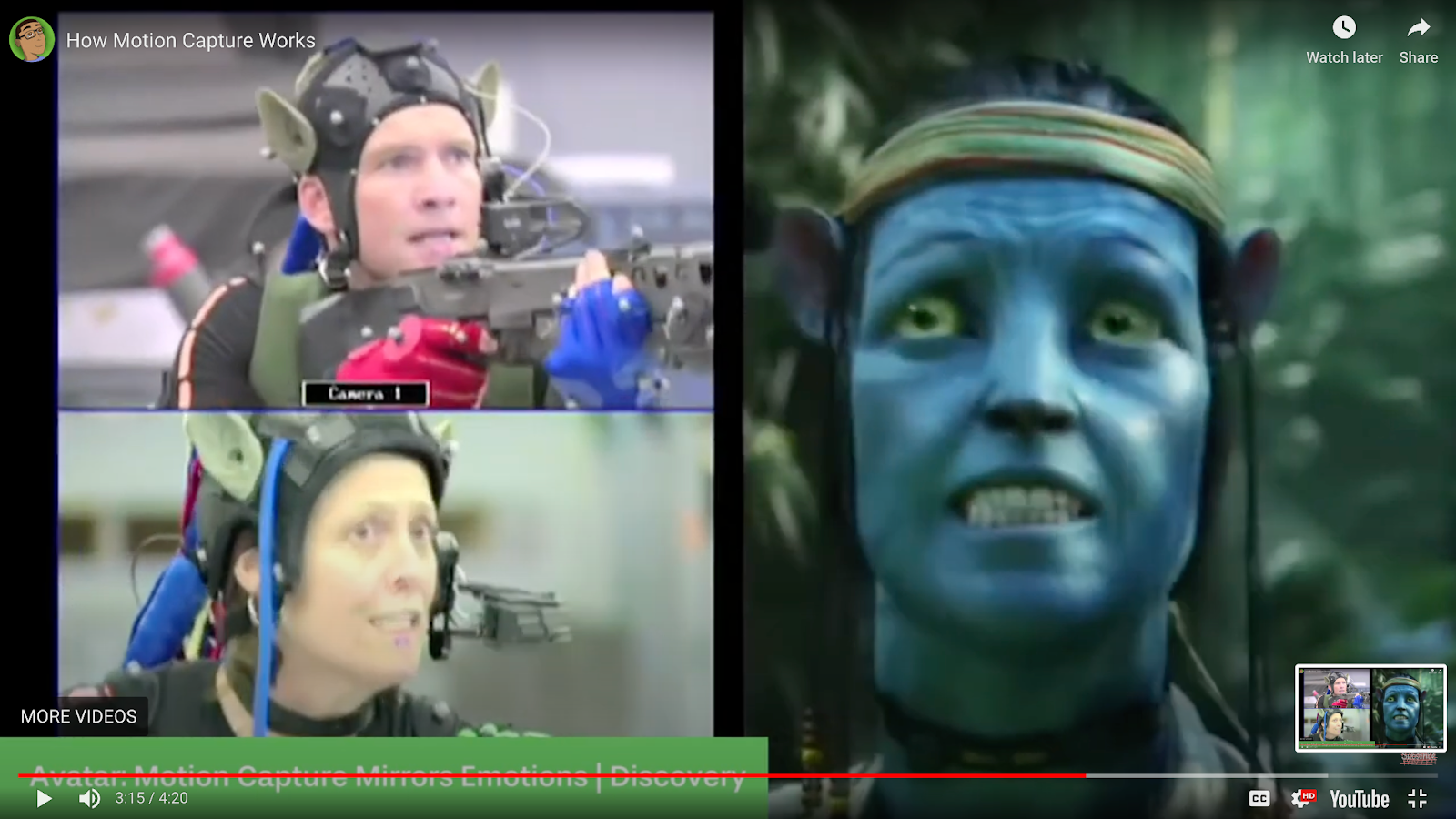
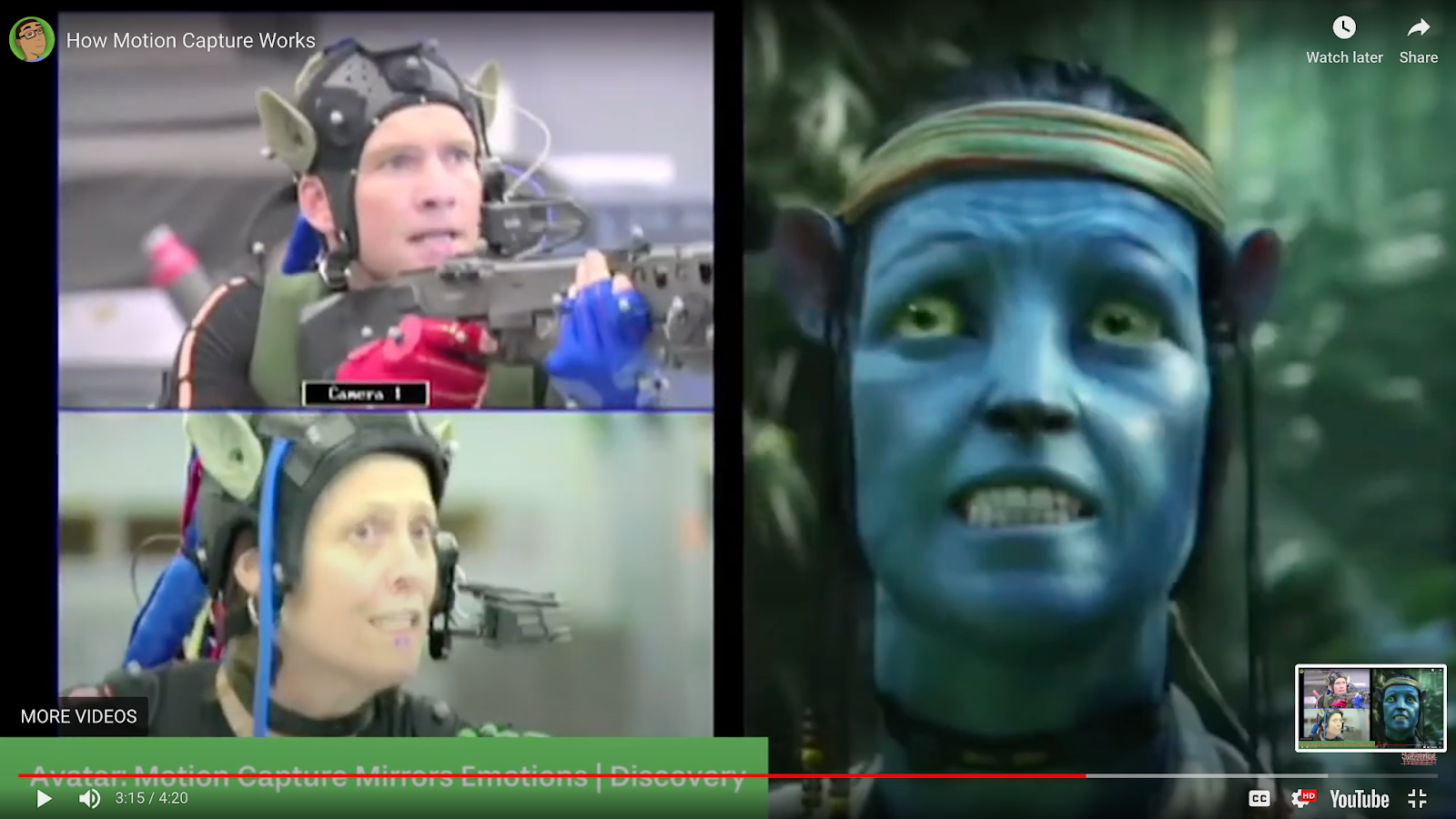
I poured an unreasonable amount of time into researching the origins of motion capture, considering that I didn’t really need to understand how it worked, but I am fascinated by conversations about the relationship between art and technology, and at what (if any) point computers replace artistry. I know everyone is talking about this right now, but this discussion of motion capture in the 1990s reminded me that these conversations are anything but new. (For a nuanced contemporary discussion of AI, digital FX, and how they’re impacting filmmaking, I recommend this episode of Sam Sanders’ excellent podcast Into It.) If you like to watch a lil' video to learn things, then this one is pretty good and, bonus, you get to see Sigourney Weaver with that big camera strapped to her head.
As fascinating/hilarious as I find these technologies, though, I keep coming back to a central question: is all this heightened visual spectacle just distracting us from these blockbusters’ material conditions of production?
Because if so, well, that’s further justification for Marcelle and I to have dedicated a whole ass episode to the film.
Heads Up! Bonus Episode Out Tuesday!
We did a Bonus Q&A dedicated to our Barbie x Petro-capitalism episode and had so much fun! We figured we’d do it again for Avatar as so many people have great hot takes, questions, concerns and queries! Be sure to subscribe to the show on your podcatcher to get notified when we release the bonus for Avatar on September 26th!
Note: Part II of the Avatar Bonus Q&A will be available on Patreon only! There are lots of other perks there for you to peruse, too!
Reading List
Here is the composite list of research I did for the episode:
https://www.bbc.com/culture/article/20221221-avatar-2-what-is-the-future-for-special-effects
http://web.mit.edu/comm-forum/legacy/papers/furniss.html
https://thereader.mitpress.mit.edu/the-staggering-ecological-impacts-of-computation-and-the-cloud/
https://www.datacenterknowledge.com/archives/2008/09/08/one-data-center-to-rule-them-all
https://www.nzedge.com/news/cg-cameron/
https://mitpress.mit.edu/9780262522793/remediation/
https://www.labyrinthproduction.com/en/1895-larrivee-dun-train-a-la-ciotat-lumiere/
Want more from Marcelle and Hannah? Subscribe to this Substack for behind-the-episode content once a month!