For Good, Fiyero, & Remembering Matthew Shepard
TW: for discussion of homophobic violence
Before I begin, I would like to acknowledge that this Behind-the-Episode is of a more delicate nature than most of our posts. In fact, I am publishing it months after the release of our Wicked: For Good episode with Leena Norms because it was hard to write and hard to “get right.” I am not sure I have done the latter, but I figured you, our listeners, deep-thinkers that you are, are the right people to share my thoughts with on the chance that this reading of Fiyero as the Scarecrow resonates with you, too.
— Marcelle
Behind the Episode: Wicked: For Good x Femslash with Leena Norms
Readers who listened to our Material Girls episode about Wicked: For Good will recall that I feel very strongly about the queer subtext of Jon M. Chu’s two-film adaptation of the Broadway musical Wicked. You may have even read my obsessive close reading of “I’m Not That Girl,” in which I argue vehemently that the song is actually about Elphaba’s love for G(a)linda. In this BTE, I want to address a different, more complicated gesture to queer love that caught my attention in For Good—a gesture that I read as a commemoration of Matthew Shepard.
Matthew Shepard was a young gay man who was the victim of a hate crime in 1998. The Matthew Shepard Foundation website recounts the event as follows: “On October 7, 1998, Matthew Shepard, a 21-year-old student at the University of Wyoming, was brutally attacked and tied to a fence in a field outside of Laramie, Wyoming and left to die. On October 12, Matt succumbed to his wounds in a hospital in Fort Collins, Colorado.”
I was fourteen or fifteen when this hate crime took place, and even though I lived over 2600km away (over 1600 miles) and in another country, I was shaken by this horrifying act of hate-induced cruelty. The details of Matthew’s murder remain hard to read and write about, but I promise they are relevant: “Two men, Aaron McKinney and Russell Henderson, abducted Matt and drove him to a remote area east of Laramie, Wyoming. [Matthew] was tied to a split-rail fence where the two men severely assaulted him with the butt of a pistol. He was beaten and left to die in the cold of the night. Almost 18 hours later, he was found by a bicyclist who initially mistook him for a scarecrow” (“Our Story” Matthew Shepard Foundation).
Following Matthew’s murder, public discourse on gay rights in the US and Canada changed drastically, and numerous works of art have sought to reckon with the hate crime and its aftermath (for example, Moisés Kaufman’s play The Laramie Project and Lesléa Newman’s book of poetry, October Mourning). And I suspect that a lot of us queers and allies who grew up at the time of Matthew’s murder felt a sense of kinship with him and grief over his death, even if we didn’t consciously turn that kinship and grief into art.
As I’ve mentioned before, Chu’s films were my introduction to Wicked. Despite having missed all the excitement for the musical in the early aughts, I have profoundly loved being part of the Wicked: Part One and For Good zeitgeist. I see myself in the story (for the record, I identify painfully with Glinda), and I see lessons in the story that are urgently relevant to our world today. I am perhaps too optimistic about or forgiving of the films, but the queerness of these movies means something to me in a way I can’t entirely articulate.
The first time I saw For Good in theatres, I didn’t know that Fiyero would be transformed by Elphaba into the Scarecrow. (In retrospect, the Boq Woodsman to Tin Woodman transformation should have warned me, but I’m not a movie viewer who tends to pre-empt the story). As a result, the scene in which the Gale Force guards drag Jonathan Bailey’s Fiyero off to a field, tie him to a fence and beat him, possibly to death, brought immediately to mind what those two men did to Matthew Shepard in October of 1998. That caught me off guard, and I didn’t consider whether this was a deliberate or accidental allusion because, in that moment, the allusion itself felt undeniable.
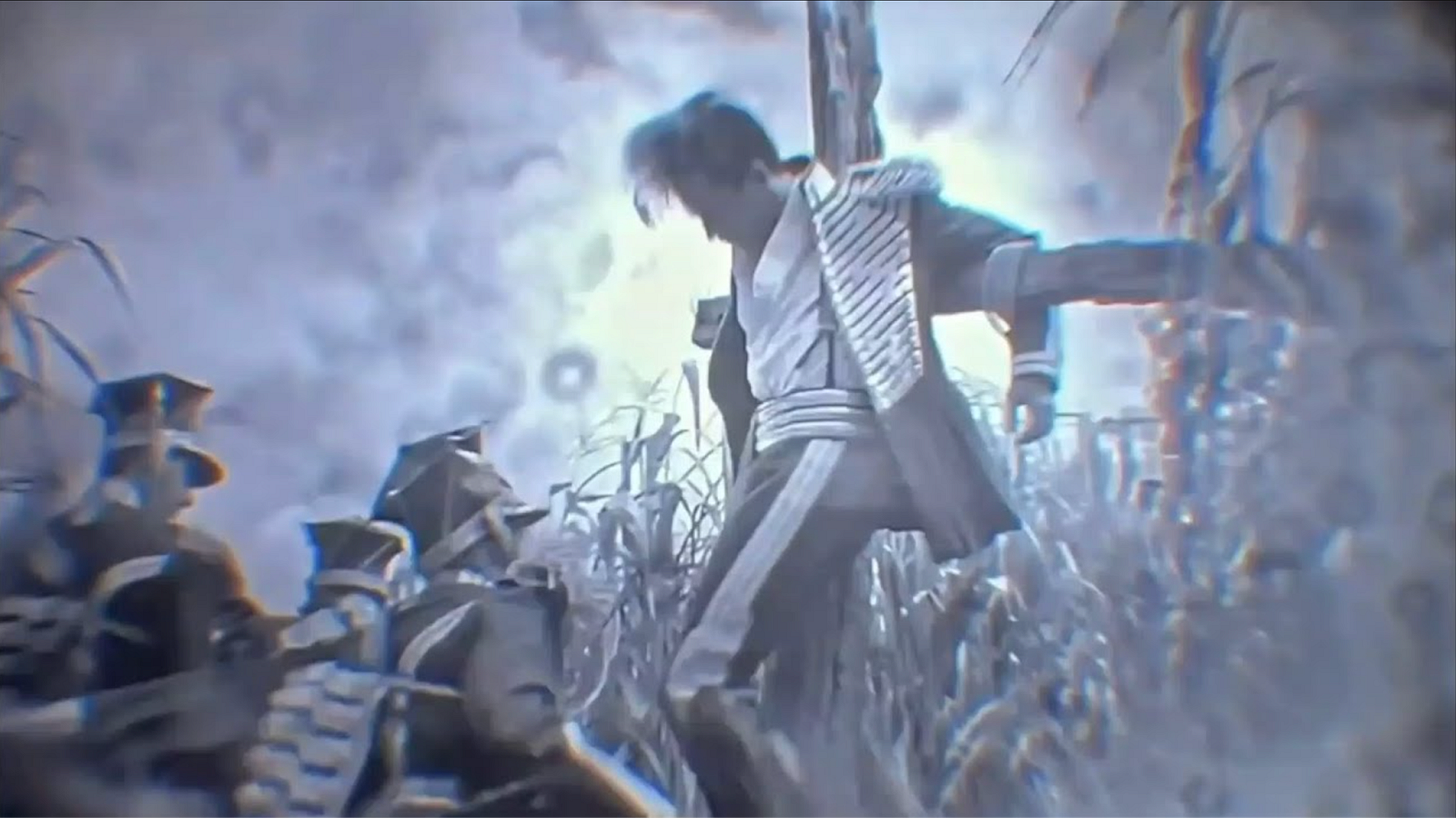
My reading of this scene was also informed by the fact that Bailey is himself an out gay public figure. While certainly not the first gay actor to play the role of Fiyero, Bailey is “one of the leading LGBTQ+ figures in the entertainment industry” (“Jonathan Bailey”), including having been named People Magazine’s “Sexiest Man Alive” (Nov 4 2025) mere days before the release of For Good in theatres (Nov 21 2025). So the film’s depiction of Fiyero captured, tied to a fence, and assaulted, were—and remain—necessarily inflected by Bailey’s queerness in a stridently homophobic world, as though I am witnessing People Magazine’s first openly gay sex symbol beaten for the audacity of being out. Fiyero is not canonically queer, but he is assaulted by officers of the state for defying Oz’s social order. One might even be tempted to suggest he is assaulted because of whom he loves.
From this scene of vicious state violence, the film shifts to Elphaba’s song “No Good Deed.” The Gale Force soldiers have dragged Fiyero off-screen. We see Elphaba’s visions of his assault and, like her, we fear the soldiers will kill him. In a desperate attempt to save save Fiyero’s life, Elphaba casts a spell from the Grimmerie, and sings:
Let his flesh not be torn
Let his blood leave no stain
Though they beat him
Let him feel no pain
Let his bones never break
And however they try
To destroy him
Let him never die
Let him never die
Of course, Elphaba doesn’t know what the spell will do and, despite her tremendous power, Elphaba believes she has failed (“since I can’t succeed, Fiyero, saving you”). This marks a turning point for her character in which Elphaba gives up trying to “do good” and embraces the relentless indictment, wicked. Only at the end of the movie do we know for certain that Elphaba has saved Fiyero’s life by transforming him into a scarecrow. Unlike a man, a scarecrow does not have flesh and bones to be torn and broken; a scarecrow cannot feel pain; and no matter who tries to destroy him, he will never die. When he finds her beneath the trapdoor, Scarecrow-Fiyero reassures Elphaba, “You saved my life.”
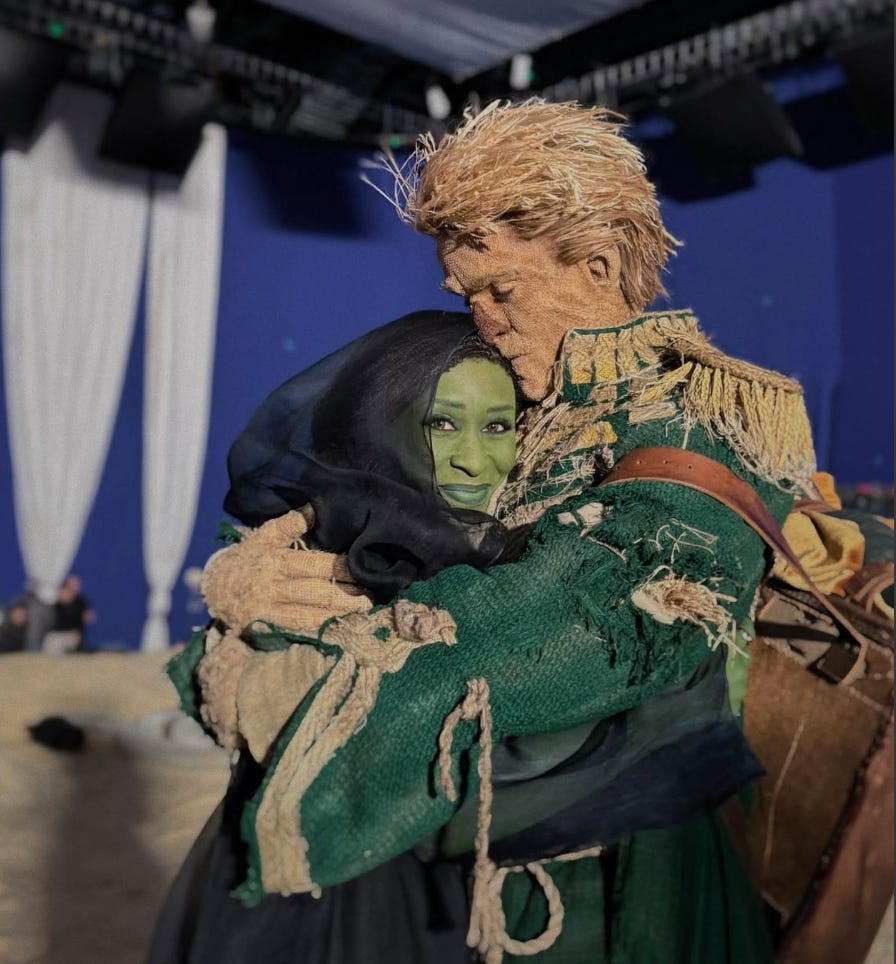
To me, this spell that saves Fiyero’s life by specifically invoking the figure of the scarecrow feels like a powerful transposition of the hate crime that so profoundly dehumanized Matthew Shepard. It feels important that in the film the Scarecrow lives. It feels important that someone who loves him calls to him from miles away and, even filled with self-doubt, saves his life. The Scarecrow survives the violence of Oz. He is changed but alive, and he walks into the sunset beside someone he loves. To me, giving the Scarecrow a future in which he is loved is a way of saying to Matthew, “You are still with us; we haven’t forgotten you,” and most importantly, “You deserved a better world.”
While I cannot speak to the intentions of either Schwartz and Holtzman or Chu, whether the visual depiction of Fiyero’s assault and transformation is a deliberate allusion to Matthew’s murder or simply a powerful example of the way his memory lives on in the queer community—these possibilities are not mutually exclusive. We tell stories to both make sense of the world, and to remake it.
We are living through an undeniably frightening time; hate and violence are proliferating in ways that often feel beyond our capacity to fight. We don’t know what to do or say, so we feel always-already defeated. But remember that the way we speak about gay rights changed drastically in the aftermath of Matthew’s death. Countless people refused to accept the social acceptability of homophobia, and they used their voices to bring a better world into being. The work of remaking the world will never be finished, but a better world is always worth fighting for.